1. Advanced Surface Modeling Techniques
In automotive design, outer sheet metal panels (such as fenders, hoods, and doors) require complex curvature profiles that cannot be easily modeled using standard solid extrusion or revolve commands. This project presents a high-fidelity CAD model of a passenger car door assembly, developed in SolidWorks utilizing advanced freeform surface modeling tools.
Key surface features and procedures modeled include:
- Curved Surface Boundaries: Sketching 3D guide curves to define the outer contour profiles.
- Boundary Surface & Lofting: Creating smooth curvature-continuous (C2) transitions across panels to ensure fluid reflection of light.
- Surface Trims & Cuts: Executing complex trims to integrate the door handle pocket, window frames, and side mirror brackets.
- Surface Knit & Solidification: Knitted individual surface patches with a 0.01 mm tolerance before applying a thickness offset (2.0 mm) to transform the surfaces into a manufacturable sheet metal solid body.
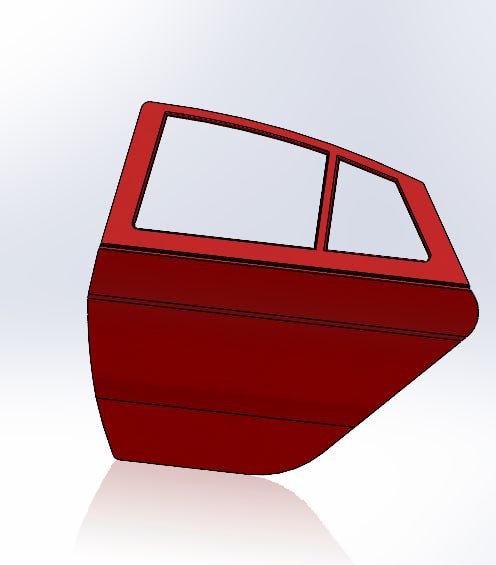 Figure 1: Finished surface CAD model of the passenger car door in SolidWorks showing sweep lines and panel divisions
Automotive Styling Summary
This model illustrates advanced surfacing competencies in SolidWorks, verifying curvature continuity, managing parting lines, and ensuring the final model is fully solid-knitted for downstream manufacturing tooling.